

Powering Africa’s digital future
Your daily intelligence briefing on African B2B tech trends and insights.

Welcome to issue 90 of the Africa B2B Tech Report Daily for 10 August 2026.
The Africa B2B Tech Report is published by BigFive Digital, a Cape Town-based independent media company focused on The Business of African Tech.
The report is produced by Charles Laughlin, BigFive Digital’s Co-founder & Chief Content Officer. Charles is a globally experienced tech journalist, podcaster, & conference producer.
The Africa B2B Tech Report is a reader-supported publication. To support our work, please consider becoming a paid subscriber.
Thanks for reading The Africa B2B Tech Report! This post is free to the public, so feel free to share it.

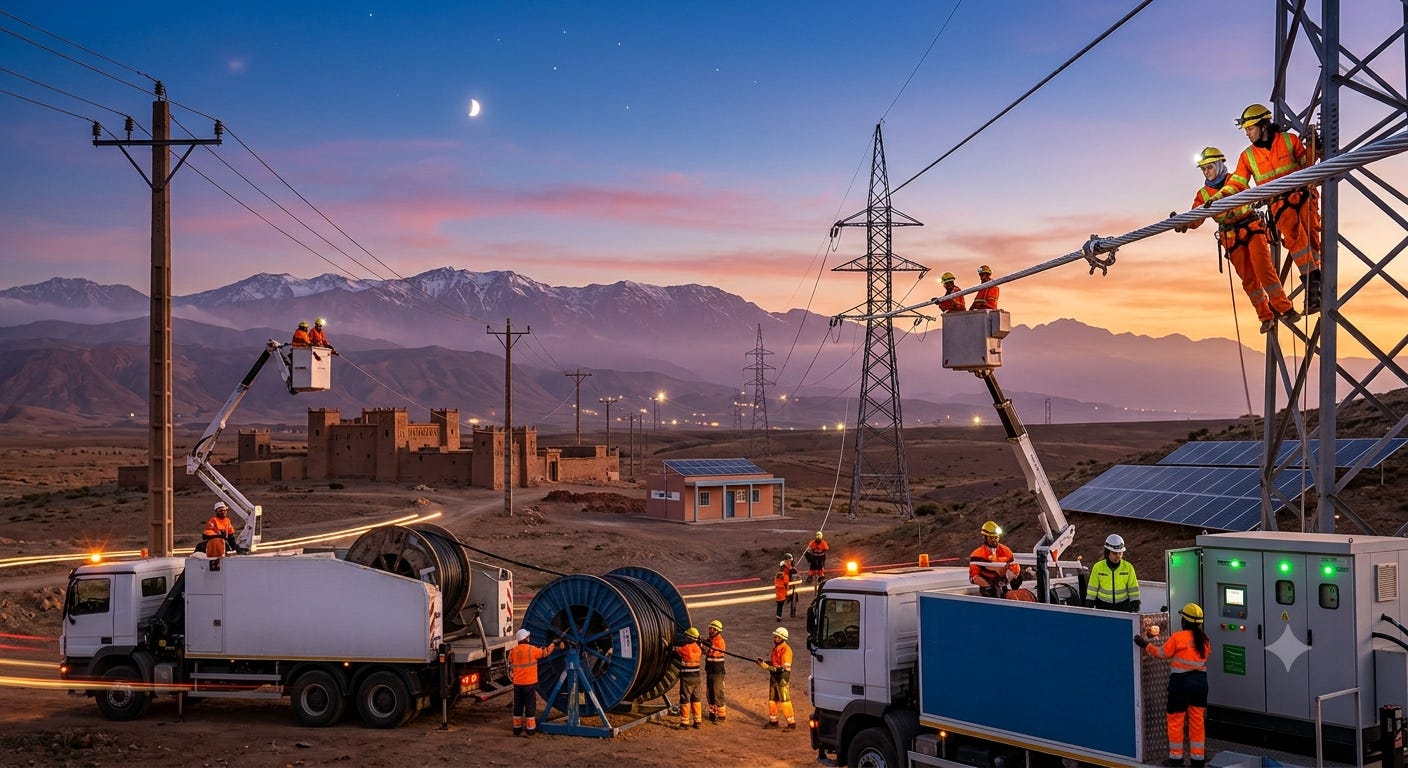
Morocco’s $2.7B infrastructure push lays foundation for digital growth
Morocco’s National Office of Electricity and Drinking Water (ONEE) has green lighted a $2.7 billion program to expand national energy and water infrastructure, accelerating power grid flexibility, renewable generation, and transmission capacity.
This massive initiative is being framed as a traditional utility upgrade. But the reality is that clean power and resilient grids are increasingly the foundational backbone of Africa’s digital economy.
Of course, preparing for the 2030 FIFA World Cup is sufficient motivation for an infrastructure upgrade. However, Morocco’s digital ambitions will also benefit.
Enterprise cloud platforms, SaaS operations, and AI data centers demand immense, uninterrupted power. Without having a capable power grid, African countries will struggle to support the Kingdom’s digital ambitions.
For example, back in May we reported on how plans for a $1 billion Microsoft-G42 data center in Kenya had faltered in part due to concerns the project might destabilize the country’s fragile power grid.
By expanding green energy capacity, Morocco is positioning itself as a key regional destination for power-intensive digital infrastructure, including green data center campuses and hyperscale investments.
The alignment between a massive traditional infrastructure upgrade and Morocco’s digital ambitions doesn’t feel coincidental.
Morocco has been systematically positioning itself as a primary digital gateway and infrastructure hub that connects Africa, Europe, and the Middle East.
Under its national Digital Morocco 2030 strategy (backed by more than $1.1 billion in initial government commitments), the Kingdom is aggressively pivoting from a traditional industrial, agricultural, and nearshore outsourcing base into a high-density, green digital economy.
Across Africa, the transition to economies based on software and digital services (vs. resource extraction) is closely linked to improving physical infrastructure.

South Africa proposes X-border crypto rules as region’s regs firm up
South Africa’s National Treasury and Reserve Bank (SARB) have introduced draft regulations bringing cross-border corporate crypto transfers under strict capital flow controls.
We read in WEEX that the South African crypto exchange VALR warned that some of the proposed provisions—including mandatory asset repatriation and surveillance requirements—could disrupt B2B operations and institutional market liquidity.
SARB’s move is part of a broader pan-African regulatory shift toward formalizing digital asset corridors.
From Kenya’s virtual asset licensing regime to Nigeria’s updated SEC digital asset framework, African central banks and tax authorities are moving in to put in place strict AML, reporting, and capital control mandates. All of this activity signals a maturing environment for crypto platforms across the continent.
Here is our quick daily roundup of the African tech and business stories we think you should be aware of, but probably didn’t have the time to read. [Original sources included.]

Today’s TLDR is supported by SALT
Connecting business with digital talent in South Africa
Founders lament drawn-out due diligence as African VC squeeze tightens
African founders report increasingly grueling fundraising cycles, with investors demanding immediate profitability and extensive due diligence before committing capital. As equity dries up and deal counts drop, early-stage entrepreneurs say they are forced to cut burn rates, pivot toward revenue generation, or turn to costly debt financing to survive the capital crunch.
TechCabal
Airtel Money launches business wallet to challenge M-Pesa
Airtel Money Kenya has launched Bizna Wallet, allowing micro-enterprises to separate business and personal funds with fee-free transfers up to KES 250,000. By eliminating charges and offering a 50% cashback scheme, Airtel directly targets Safaricom’s dominant M-Pesa ecosystem, intensifying competition for Kenya’s lucrative informal merchant market.
Connecting Africa
South Africa taps WhatsApp for voter registration
In a nod to WhatsApp’s ubiquity across South Africa, the Electoral Commission of South Africa (IEC) has launched voter registration directly on the messaging app. Eligible citizens can now register, verify identity, and update voting details via chat, leveraging WhatsApp’s massive reach ahead of upcoming local government elections.
TechCabal
Smallest.ai building model to mirror human speech
Voice AI startup Smallest.ai has raised $13 million in Series A funding to build ultra-fast, sub-second latency speech models that mirror human conversation. For African markets, these lightweight, low-latency models can drive automated voice services across local languages.
TechCrunch
Ghana’s Howyin launches ‘livestream commerce’ platform
Ghanaian technology company Howyin Platforms has formally launched Howyin, a livestream commerce platform combining digital storefronts, live shopping, secure payments, creator monetization, and integrated logistics. The platform currently reaches more than 35,000 registered users across 73 countries.
The B&FT
Glovo: Kenya gig economy regulation needed
Glovo Kenya argues that Kenya urgently needs balanced, “smart” gig economy regulations to safeguard its KES 133 billion platform economy. Writing in Business Daily, Kiplimo Kigen, Glovo Kenya’s Global Affairs Lead, argues that policy frameworks must protect courier welfare and fair earnings without sacrificing the flexibility that makes gig work a vital digital youth employment engine.
Business Daily
AfCFTA to digitize customs operations
The African Continental Free Trade Area (AfCFTA) Secretariat has signed a 20-year, $3.1 billion deal with Nigerian firm Bergmans Security to digitize customs operations across 50 member countries. The project aims to eliminate border delays, curb revenue leakages, and double intra-African trade by 2035.
Fibre2Fashion
TVS raises stakes on EV competition in Kenya
Indian manufacturer TVS Motor Company has entered Africa’s electric vehicle market by launching its flagship iQube electric scooter in Kenya. Distributed via local partner Car & General, the expansion taps into East Africa's rising EV demand, offering two variants designed to reduce urban commuter running costs.