

Ripple makes waves in Africa
The Africa B2B Tech Report, Africa-Middle East B2B tech news & insights for 17 June 2026.

Welcome to issue 52 of the Africa B2B Tech Report Daily. We bring you a daily digest of the news that matters to The Business of African Tech.
The Africa B2B Tech Report is published by BigFive Digital, an African tech media and events firm that produces the annual BigFive Summit in Cape Town. The report is produced and edited by Charles Laughlin, BigFive Digital’s Co-founder &Chief Content Officer. Charles is a globally experienced tech journalist, podcaster, & conference producer.
The Africa B2B Tech Report is a reader-supported publication. To support our work, please consider becoming a paid subscriber.
Thanks for reading The Africa B2B Tech Report! This post is free to the public, so feel free to share it.
Here are some recent stories that matter to The Business of African Tech.
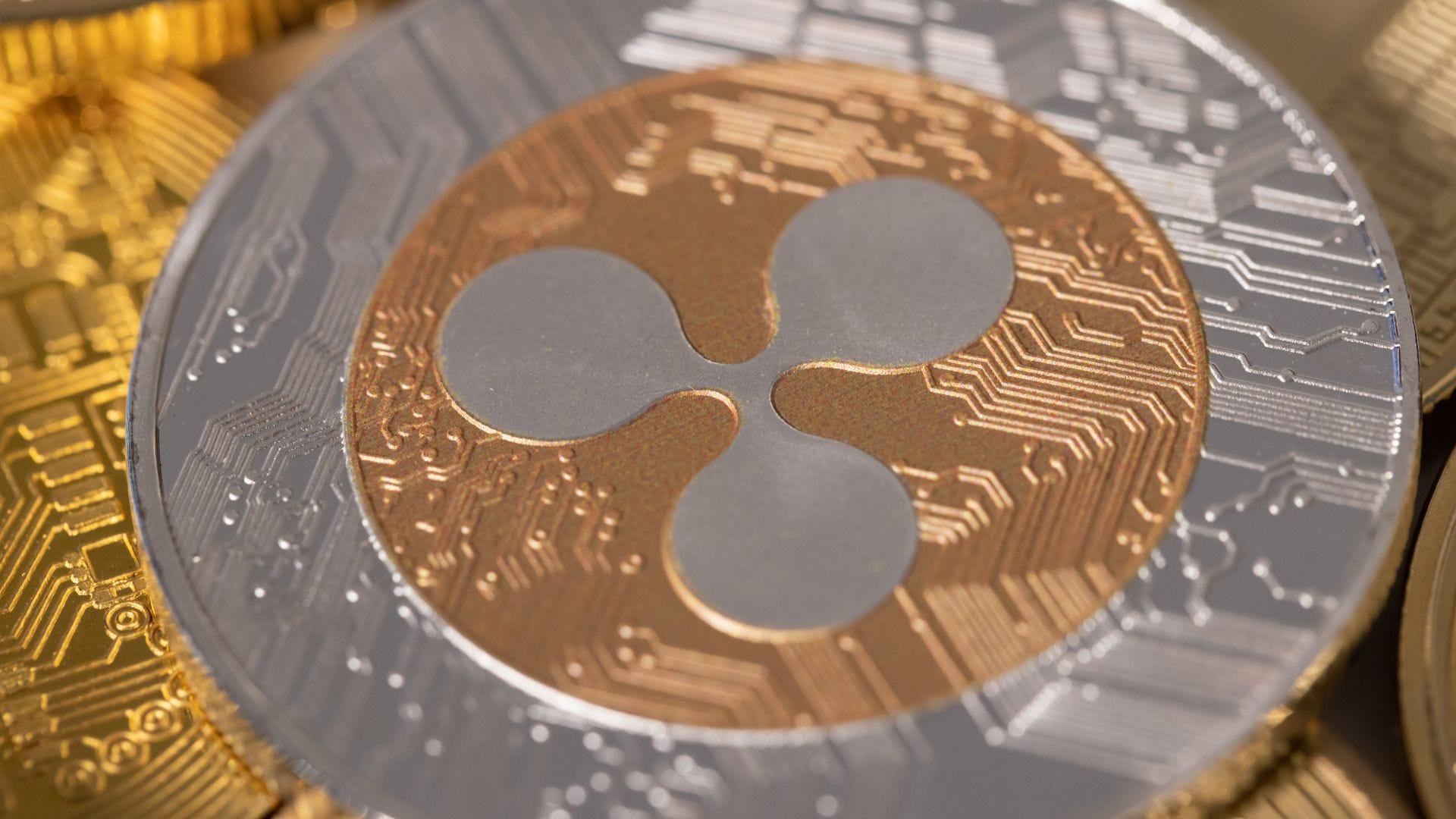
Ripple backs Flutterwave Series E to anchor Africa’s stablecoin infrastructure
The race to dominate Africa’s emerging stablecoin economy has intensified now that blockchain provider Ripple (of XRP fame) has invested in African payments infrastructure powerhouse Flutterwave’s Series E funding round.
This latest round values Flutterwave at $3.2 billion.
This is not just a capital injection. Flutterwave will integrate Ripple’s USD-backed stablecoin (RLUSD), the XRP Ledger, and a unified API directly into its core payment rails and Send App remittance corridors.
The goal is to establish a “stablecoin-first” architecture to bypass traditional cross-border friction, such as multi-day settlement delays and volatile foreign exchange margins.
This partnership highlights the soaring importance of stablecoins in Africa. Severe local currency fluctuations and high remittance costs have helped to shift digital assets from speculative trading tools to essential mainstream business utilities.
For Ripple, the move is a masterstroke in distribution. By backing Flutterwave, Ripple inserts RLUSD straight into a massive network spanning 34 African countries. It gains a dominant, regulated gateway to drive massive transactional volume over the XRP Ledger, establishing its ecosystem as the foundational plumbing for real-world pan-African liquidity.
Whither the IPO?
Another angle to the Series E is what it says about Flutterwave’s long-awaited IPO.
One way to look at the Series E (and Ripple’s investment in particular) is as a signal of stability on the eve of an IPO that almost everyone believes is eventually coming.
Before an IPO, institutional public investors look for indicators of operational stability and technological defensibility. By bringing in a serious player like Ripple at the equity level, Flutterwave secures a key global stamp of approval.
As Flutterwave CEO “GB” Agboola noted, this is a “very big endorsement” that demonstrates enterprise-grade confidence in the company’s compliance, security, and scalable infrastructure. These are key boxes to check for any New York or London listing.
Also, the valuation boost the Series E provides can’t hurt on the eve of an IPO.
Key milestones on the march to a stablecoin economy
Sub-Saharan Africa has quietly become the global leader in stablecoin adoption among crypto-active users, with a staggering 79% of crypto-active users using stablecoins to combat local currency volatility and bypass costly legacy remittance networks.
Over the past 12 months, the conversation has rapidly shifted from speculative retail trading to heavy enterprise infrastructure. The following chat offers a timeline of major institutional deals and partnerships. It illustrates the immense momentum building across Africa’s stablecoin ecosystem.
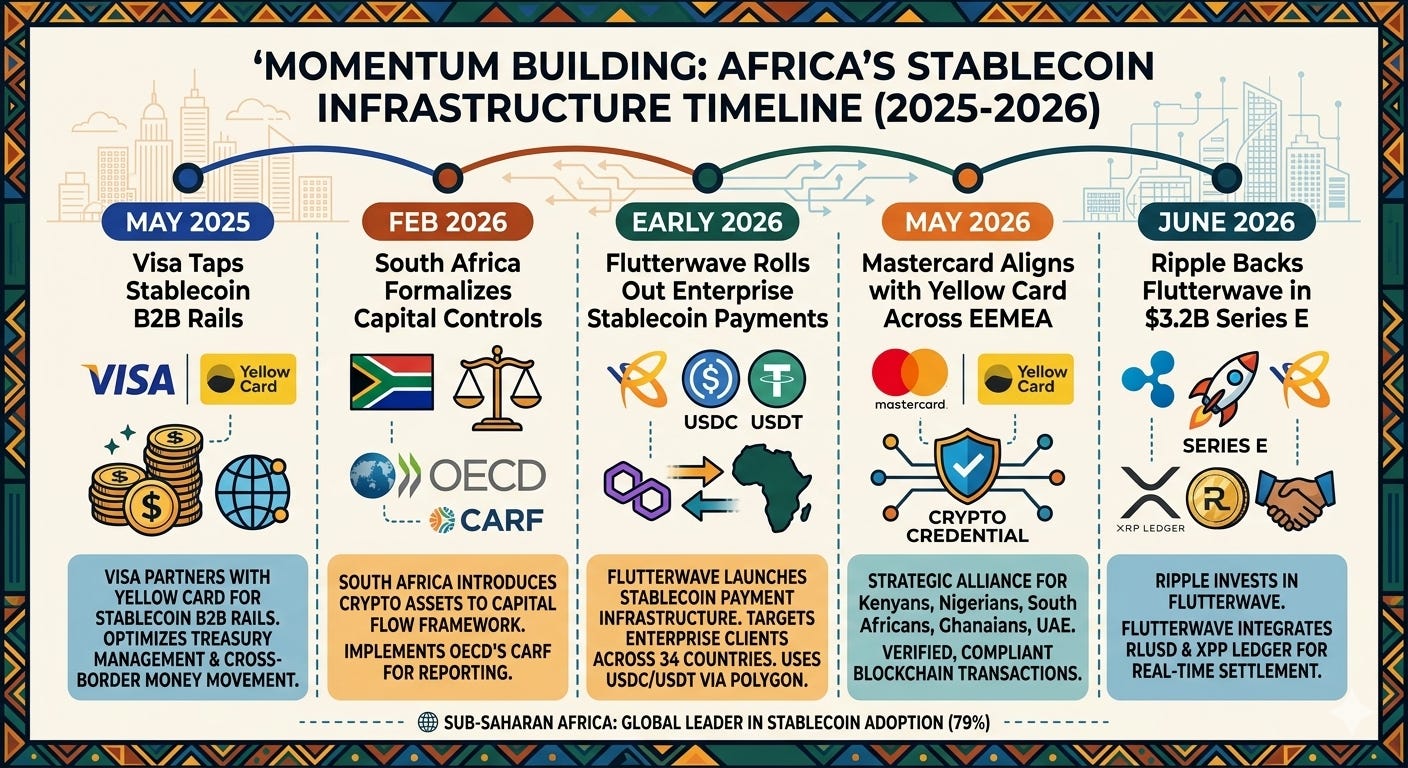

We regularly share infographics telling important stories about The Business of African Tech.
Remittances are a key economic lifeline in Africa
The conversation around the emergence of Africa’s stablecoin economy cannot take place without acknowledging the central role of remittances. Stablecoins are at the center of every conversation about how to make remittances better.
Today, remittances are slow and expensive. Stablecoins can make them faster and cheaper. This chart (which we found courtesy of Les Africanistes) illustrates just how massive this unlock could be.
In many large African countries, remittances account for up to 10% of GDP. In a few cases, it is as high as 20%.
In Egypt, one of Africa’s largest economies, remittances account for between 5% and 10% of GDP. Egypt’s GDP is $430 billion. At the low end of what this chart estimates, remittances funnel $22 billion into Egypt’s economy each year. In Nigeria, with a GDP of $377 billion, the low-end estimate, based on this chart, is $19 billion.
If stablecoins drive down fees on remittances, as promised, this translates directly into food, medicine, and shelter for African families.

Check out this clip from our 2026 BigFive Summit in Cape Town. Investor Zach George explains why stablecoins are such a godsend for remittances and such a huge fintech opportunity this year.