

Takealot Group's resilience and more
The Africa B2B Tech Report, Africa-Middle East B2B tech news & insights for 30 June 2026.


Welcome to issue 61 of the Africa B2B Tech Report Daily. We bring you a daily digest of the news that matters to The Business of African Tech.
The Africa B2B Tech Report is published by BigFive Digital, an African tech media and events firm that produces the annual BigFive Summit in Cape Town. The report is produced and edited by Charles Laughlin, BigFive Digital’s Co-founder &Chief Content Officer. Charles is a globally experienced tech journalist, podcaster, & conference producer.
The Africa B2B Tech Report is a reader-supported publication. To support our work, please consider becoming a paid subscriber.
Thanks for reading The Africa B2B Tech Report! This post is free to the public, so feel free to share it.

Here are some stories that matter to The Business of African Tech.
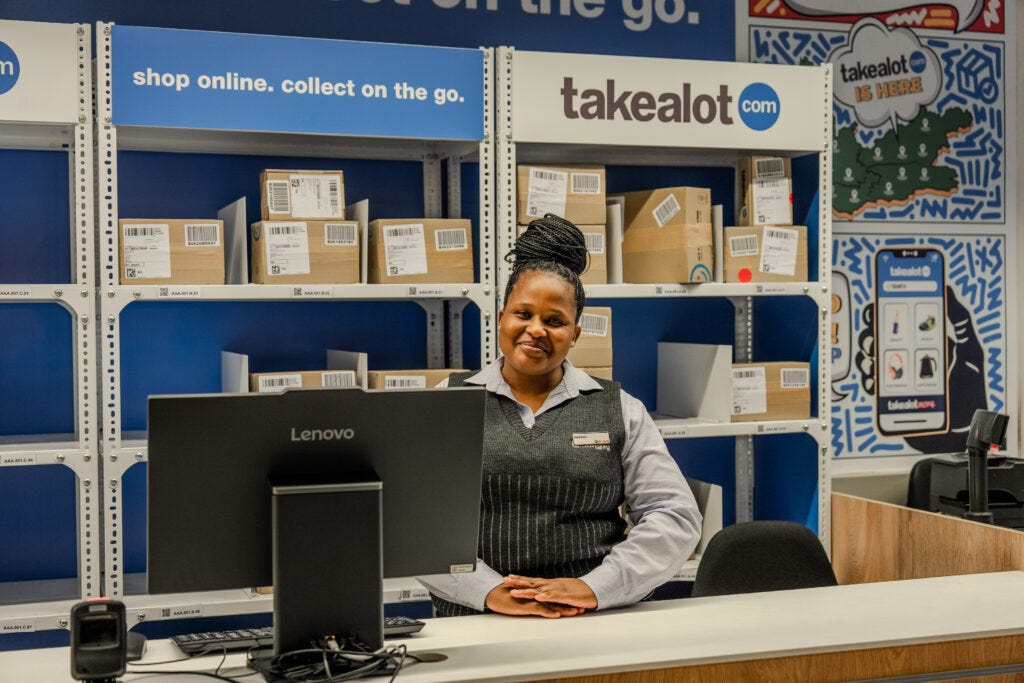
Amazon rivalry doesn’t deter SA’s Takealot Group from reaching profitability 15 years post launch
South Africa’s homegrown e-commerce ecosystem, Takealot Group, has achieved full-year profitability for the first time since its 2011 launch. Parent company Naspers (Africa’s most valuable company) reported an adjusted operating profit of $11 million for the fiscal year ending March 31, 2026. This marks a significant turnaround from the $13 million loss Takealot recorded the previous year.
Group revenue climbed 19% to reach the $1 billion milestone. Takealot has successfully defended its domestic market share against Amazon’s recent local entry.
The group’s maturation runs on a strategic shift away from direct retail toward a platform playbook. Its paid subscription service, TakealotMORE, successfully captured 27% of Takealot.com’s gross merchandise value.
The group is also aggressively onboarding Chinese marketplace vendors and scaling its high-growth B2B logistics arm, Takealot Fulfilment Solutions (TFS), which saw a 93.5% revenue spike. Moving forward, TFS will operate as a standalone revenue stream to monetize Takealot’s extensive logistics network for external business clients.

Mastercard Study: SA’s SMEs show strong digital and Commercial maturity
A new Mastercard study reveals that South African SMEs are showcasing advanced digital and commercial maturity. Defying regional economic headwinds, local entrepreneurs are rapidly moving past basic digital adoption to integrate advanced B2B automation tools, omni-channel payment rails, and cloud-based financial infrastructure to safeguard cash flow and scale regional enterprise capabilities.
Sowetan
Mauritius rolls out fintech strategy designed to modernize payments
The government of Mauritius has unveiled its National Fintech Strategy 2026–2030, a roadmap developed with UN support to establish the island as Africa’s premier digital finance hub. The plan aims to capture a share of Africa’s projected $65 billion fintech market by 2030 through open banking frameworks, streamlined regulatory sandboxes, AI adoption, and cross-border payment integration designed to fuel regional SME trade.
WeAreTech.Africa
Stabyl emerges from stealth with $2.7M for institutional FX infrastructure
Nigeria-based financial infrastructure startup Stabyl has closed a $2.7 million pre-seed round led by e-commerce giant Konga. Moving away from manual, phone-based treasury operations, Stabyl offers a central limit order book that automatically matches wholesale foreign exchange orders for banks, payment providers, and large corporations. Settling transactions via traditional banking rails or stablecoins (USDT/USDC), the platform targets the continent’s fragmented, high-friction B2B liquidity gap to dramatically accelerate cross-border settlement speeds.
WeAreTech.Africa
How fintech rails are unlocking Africa’s digital entertainment market
Africa’s fintech boom is rapidly dismantling barriers to digital entertainment. Neobanks and embedded finance players like Chipper Cash and Kuda are layering virtual card infrastructure atop mobile money, allowing unbanked consumers to instantly access global streaming and gaming subscriptions. Consequently, platforms are aggressively shifting focus toward regional pricing and localized content distribution.