

The BigFive Digital 2026 AfricaTech Preview
As we look back on 2025, we offer our list of the stories we plan to watch in 2026.


What stories mattered in 2025
The year 2025 was a consequential spin around the Sun for Africa’s tech ecosystem. We saw a meaningful rebound in startup funding and big investments in Africa’s AI infrastructure. We also witnessed the emergence of cleantech as a major focus of investors, to the point where it began to rival fintech, long the crown jewel of African tech investing. Here’s a quick summary of just a few of the stories that we believe mattered in 2025.
The $3 Billion Funding Rebound
After two years of decline, in 2025, African startup funding surged back, surpassing the $3 billion mark. This recovery was driven by a 50% year-on-year increase in deal value, with Africa’s “Big Four” — Nigeria, Kenya, Egypt, and South Africa — accounting for the bulk of deal value.
Cleantech rivals fintech for the first time
In a historic shift, cleantech (e.g., climate tech) funding nearly equaled fintech’s dominance. By Q3 2025, cleantech accounted for nearly $1 billion in capital, largely fueled by debt financing and infrastructure-led investments in renewable energy and water tech.
UAE’s $1 billion “AI for Development” program
At the G20 Summit in Johannesburg in November 2025, UAE President Sheikh Mohamed bin Zayed Al Nahyan announced a $1 billion initiative to deploy AI solutions across Africa. The fund focuses on improving agricultural yields, healthcare diagnostics, and government efficiency.
World Bank’s $500 million FINCLUDE project
In December, the World Bank approved the FINCLUDE project in Nigeria. This $500 million package aims to digitize credit for 250,000 SMEs using AI-enabled platforms to modernize loan appraisals and promote financial inclusion for women-led businesses.
Mastercard’s 45% African network expansion
Mastercard achieved a milestone by expanding its African acceptance network by 45% within a single year. The expansion brought millions of new consumers and small businesses into the digital economy, focusing on QR-on-card solutions and cross-border trade for SMEs.
Egypt’s Proptech landmark: Nawy’s $75M Raise
In May, Cairo-based proptech Nawy secured $75 million in a combined equity and debt round. This deal highlighted the maturation of North Africa’s real estate tech sector and Nawy’s expansion into the UAE and Saudi Arabian markets.
Nigeria’s $500M “BRIDGE” broadband expansion
The World Bank approved a separate $500 million loan for Nigeria’s BRIDGE project, designed to expand the national fiber-optic backbone from 35,000 km to 125,000 km. This effort is expected to increase broadband penetration to more than 70% of Nigeria’s population.
Africa CDC and Zipline drone logistics partnership
The Africa Centres for Disease Control and Prevention (Africa CDC) signed a landmark MoU with Zipline in late 2025 to establish a continent-wide drone delivery network for vaccines, blood products, and essential medicines, aiming to reach underserved rural areas.
Kenya’s National AI Strategy launch
In March 2025, Kenya officially launched its National AI Strategy, positioning the country as a regional leader in AI ethics and regulation. The strategy includes the creation of an AI research hub and tax incentives for AI-focused startups.

What stories will matter in 2026
Looking ahead to the new year, we expect to see some trends that have been developing over the past few years begin to take shape and deliver results. This includes everything from intra-continental trade frameworks to technology projects that promise to modernize the continent’s infrastructure to the advancement of Africa’s AI economy. And finally, 2026 looks to be a big year for African IPOs.
The AfCFTA Digital Trade Protocol implementation
After years of negotiation, 2026 is poised to be the year that the Digital Trade Protocol of the African Continental Free Trade Area (AfCFTA) moves from policy to practice.
The Story: Watch for the rollout of the “Digital Trade Corridors.” These corridors will ideally standardize the rules for cross-border data transfers, digital signatures, and electronic payments across 54 countries.
Why it matters: The Digital Trade Protocol aims to solve the “fragmentation problem” that has forced African startups to navigate different regulations for every market they enter.
The completion of the “Umoja” and “Medusa” cables
2026 will be a landmark year for continental connectivity as two major subsea cable projects become operational.
The Story: Google’s Umoja cable, the first to directly link Africa (Kenya) to Australia, is expected to be completed in early 2026. Simultaneously, the Medusa cable (linking Southern Europe to North Africa) will launch its first phase, connecting Morocco and Tunisia to Europe with high-capacity fiber.
Why it matters: These cables provide critical redundancy, preventing the massive internet outages seen in early 2024 and lowering data costs for landlocked countries like Rwanda and Uganda.
The AI agent era in African Fintech
According to 2025 business surveys, 26% of African businesses are planning to allocate more than 20% of their tech budgets to AI in 2026.
The Story: The focus will shift from “Generative AI” (chatbots) to “Agentic AI”—autonomous tools that handle back-office workflows. In 2026, expect fintechs and banks to deploy AI agents for real-time KYC (Know Your Customer) and automated credit underwriting for the informal sector.
Why it matters: This will target the “SME credit gap” more effectively than manual banking systems ever could.
Nigeria’s sovereign semiconductor push
Following successful pilot programs in 2025, Nigeria is expected to break ground on its first ATMP (Assembly, Testing, Marking, and Packaging) facilities in 2026.
The Story: Nigeria is moving into the “hard-tech” frontier, aiming to design and package energy-efficient chips specifically for the African environment (heat-resistant, low-power for IoT applications).
Why it matters: This marks a shift from being a software-only economy to building the physical hardware that powers the continent’s digital transformation.
The IPO grand slam in Egypt and South Africa
With market maturation and the successful $1.4B listing of Optasia in 2025, 2026 is predicted to be the busiest year for African tech IPOs in a decade.
The Story: As many as eight major tech-related listings are expected across the Egyptian Exchange (EGX) and Johannesburg Stock Exchange (JSE). Key sectors to watch include proptech, healthtech, and mature fintech aggregators.
Why it matters: Successful domestic exits will prove to global investors that African tech is a liquid asset class, encouraging a new wave of early-stage venture capital.
Sponsored Message
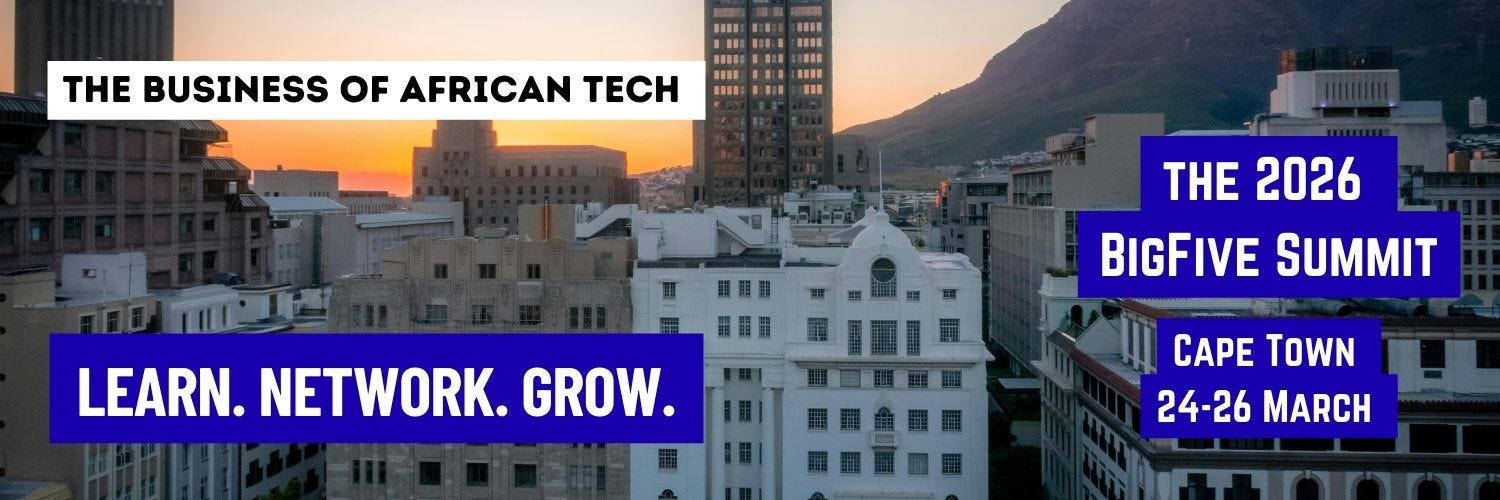
The 2026 BigFive Summit
Tickets are now available for the 2026 BigFive Summit, 24-26 March at Innovation City Cape Town. This year’s summit theme is “The Business of African Tech”.
Since our first event in 2019, the BigFive Summit has served the community that builds, invests in, and takes to market new technology solutions that help African businesses thrive.
Generous early bird rates (>25% savings) are in place through February, so it pays to make an early decision to join one of the Continent’s top technology events.
Purchase your Summit tickets here:
Build Your Personal and Corporate Brands at the 2026 BigFive Summit
BigFive Summit sponsors receive a host of benefits — branding, stage time (with shareable video content), exclusive event sponsorships within the Summit (dinners, giveaways, tea breaks, etc.), early and exclusive access to the Summit delegate list with contact details, curation of meetings, and much more.
Whatever your business stage or budget level, there is a sponsorship opportunity for you. Learn more by downloading our sponsor prospectus.
Brilliant overview of the African tech landscape. The cleantech/fintech parity point is underrated, becuase it shows capital is finally flowing toward longterm infrastructure instead of just quick consumer apps. Been tracking Nigeria's BRIDGE project since announcement, the 125k km expansion could be a gamechange for rural SME access if executed right. Wonder how the AfCFTA digital corridors will interact with existing regulatory frameworks tho.